Showing posts with label News. Show all posts

Thursday, April 3, 2014

Indonesian Property Market Outlook 2014

In 2014 Indonesia will held its legislative and presidential election (scheduled on 9 April and 9 July). It will be Indonesia's third direct presidential election. However, the country seems to be lacking two factors. With no strong political figure on the horizon and a current economic slowdown, the uncertainty and risk could be somewhat higher this time round. It can be seen from the last quarter that the market is taking a wait-and-see approach. In line with slowing economic expansion of Indonesia, the country's property sector also decelerated. If the elections will run orderly and results are well-received by the market then the sector can accelerate again

The last three years have been very strong as Indonesia’s economy continued to perform strongly with its large, increasingly affluent, young and urbanizing population underpinning demand for all types of real estate. When we combine this with ultra-loose monetary policy from across the world, the result was a very conducive environment for the property market.

However, in the last semester the market has beginning a slowdown.  While growth has remained positive, the speed of price increases and absorption rates has slowed from the record levels over the past 2 years. The impact by sector will be as follows:
  1. Office, scarcity of new supply and the on-going process of companies upgrading their space will mean that the market should remain firmly in favor of the landlord, particularly at the high-end of the market, for at least the next two years. Rents will continue to rise albeit at a slower pace throughout 2014.
  2. Retail, The retail property sector will continue to remain solid as occupancy levels remain at an all-time high and demand from local and foreign retailers to enter and expand their presence in the country continues. Mall rentals will continue a steady increase over 2014. 
  3. Condominiums, the demand for condominiums over the past three years has been very strong as Jakartans have taken to inner city living. 
  4. Hotel, the hospitality sector has been a net beneficiary of the depreciating rupiah with occupancy levels, room rates and resultant land and capital values continuing to increase on continued strong demand. 

Indonesia Most Trending Topic 'The JOKOWI EFFECT'


Known locally as JOKOWI, the Jakarta governor is widely regarded as a shoo-in for top job in Indonesia, the world's third largest democracry.


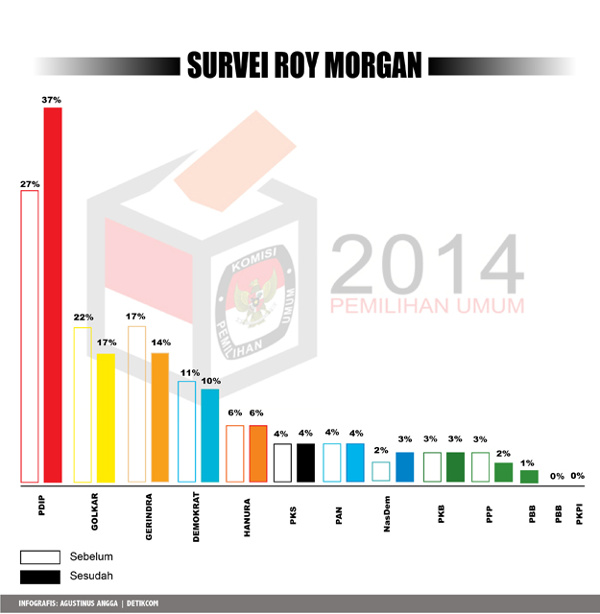
The 'JOKOWI EFFECT' has boosted his party (PDI-P) ratings. As soon as his candidacy for the presidential race was announced, PDI-P's fortune jumped from 27 percent to 37 percent. 

Source : news.detik.com


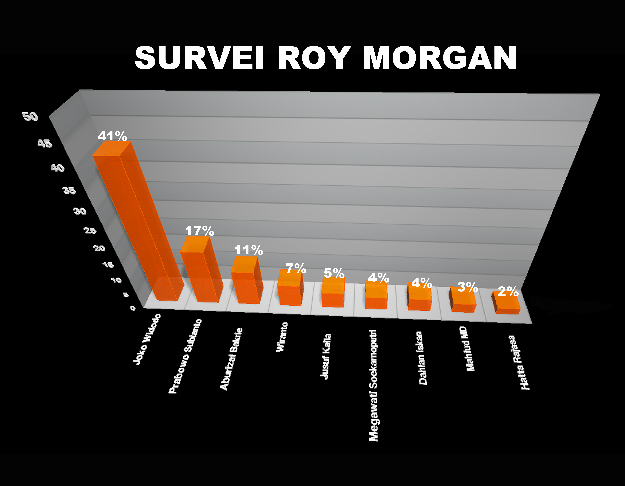
Support for JOKOWI leapt to 41 percent, according to survey released Wednesday by Roy Morgan International. The survey showed support for rival Prabowo Subianto holding at 17 percent, while Aburizal Bakrie trailed with 11 percent.

Source : news.detik.com

Wednesday, April 2, 2014

Indonesia Posts $785 Million Trade Surplus in February 2014

After announcing the low March inflation rate (0.08 percent), Indonesian Statistic Bureau (BPS) also released positive news about Indonesia's trade balance. 

In February 2014, Indonesia recorded a $785 Million trade surplus, supported by a USD $1.85 billion surplus in the non-oil and gas sector. Exports rose 0.68 percent (month-to-month) in February 2014 to USD $14.57 billion, while imports declined 7.58 percent to USD $13.78 billion.

Indonesia Records 0.08% of Inflation in March 2014

Indonesian Statistic Bureau (BPS) announced that inflation rated was recorded at 0.08 percent in March 2014, considerably lower than February 2014 (0.26 percent) and March inflation (0.63 percent). On a year-on-year basis, Indonesian inflation eased to 7.32 percent from 7.75 percent in February 2014.

Indonesian Rupiah Strengthen on Domestic Data

On Tuesday (01/04/2014) Indonesian rupiah have shown a positive performance after data that's forecast to show the trade balance returned to surplus and inflation slowed. Based on Bloomberg Dollar Index, the rupiah appreciated 0.64 percent to IDR 11,288 per US dollar.

Indonesian Statistic Bureau (BPS) announcement supported the rise of Indonesia's rupiah. The announcement showed that inflation had eased further in March 2014. On a year-on- year basis, inflation now stands at 7.32 percent, down from 7.75 percent in February 2014. Moreover, BPS posted an unexpectedly large trade surplus in February 2014, thereby reducing concerns about the country's current account deficit.The trade surplus was recorded at USD $785 million in February.

Thursday, March 27, 2014

World’s Hottest Property Market

Where’s the hottest luxury real estate market in the world? Try JAKARTA – for the second year in a row. 

According to Knight Frank’s Prime Global Cities Index, which tracks luxury real estate markets in 30 cities around the world, prices for top homes in the Indonesian capital rose more than in any other city, up 37.7% at the end of 2013 from the year before.

Liam Bailey, Knight Frank’s global head of residential research, cited “very limited supply” and “very strong” demand as factors driving Jakarta’s high luxury property prices, “even if the Indonesian economy isn’t as strong as it was maybe two years ago.” It’s the second year in a row Jakarta has topped the list. In 2012, the city saw its upper echelon of homes jump 38% in price from 2011.
The increase in Jakarta was more than double the price rise in second-ranked Dublin (17.5%) and Beijing (17.1%). Ranking No. 4 and 5, respectively, were Dubai (17%) and Los Angeles (14%). The brokerage firm, which released its quarterly update on Tuesday, defines “prime real estate” as homes that were sold in the top five percentile in terms of value.
Meanwhile, Singapore and Hong Kong, which were once hot real estate markets in Asia just three years ago, have cooled thanks to government measures, such as higher stamp duties, intended to restrict speculation and foreign buying. Specifically, these measures have “impacted the flow of Chinese money coming into those markets,” Mr. Bailey said. Those two markets saw slight decreases in 2013 – Singapore was down 0.8% and Hong Kong declined 2.2%. 

Among the global financial centers, New York ranked No. 9 (10.4%) and London ranked No. 12 (7.5%). Which way is the global real estate market heading in 2014? Look to London, Mr. Bailey said. “It’s the bellwether. Price growth is strong but it’s going down. We’re seeing the effect of the fear of rising interest rates,” he said.
See the full list of the 30 cities in the Knight Frank Prime Global Cities Index, ranked by price increases in last quarter of 2013 compared to the same year-earlier period.

Knight Frank Prime Top 10 Global Cities Index
  1. Jakarta 37.7%
  2. Dublin 17.5%
  3. Beijing 17.1%
  4. Dubai 17.0%
  5. Los Angeles 14.0%
  6. Tel Aviv 12.7%
  7. Bangkok 12.3%
  8. San Francisco 10.4%
  9. New York 10.4%
  10. Sydney 9.3%
Source : The Wall Street Journal

Jakarta Property market remain prospective despite Indonesia's slowing economy

Jakarta's property market remains prospective despite Indonesia's slowing economy and the upcoming legislative and presidential elections (scheduled for 9 April and July 2014). The apartment (particularly luxurious apartments) and condominium segments in Indonesia's capital city will continue to post growth as they have done in recent years. Generally, around 90 percent of the units of a new project are sold before construction is finished.
 
In line with slowing economic expansion of Indonesia (from 6.23 percent in 2012 to 5.78 percent in 2013), the country's property sector also decelerated. Moreover, the upcoming elections bring temporary uncertainty about what the new government's stance on property development or general economic growth will be. If the elections will run orderly and results are well-received by the market then the sector can accelerate again according to Rowe. Lastly, the higher interest rate environment and sharply depreciated rupiah exchange rate in 2013 have also impacted negatively on Indonesia's property sector.

 Characteristic of property sales in Jakarta is that about 74 percent of a new project is already sold before construction has started, while about 90 percent of the project is sold by the time construction has finished. In other countries, generally, 30 percent is sold before construction of the project has commenced, 50 percent when the roof is closed, and 70 percent when construction has finished.


Source : Indonesia Investment